Fake Nose and Glasses
Straight ManThe Fake Nose and Glasses begin as an offhand gift from Charles Purty and become an unlikely part of William Henry Devereaux, Jr.’s public protest. Their progress from pocketed novelty to office costume to television image gives the objects a changing function: they promise disguise, invite comedy, and finally make Devereaux more conspicuous. The joke depends on a gap between how exaggerated he imagines the disguise to be and how ordinary, even plausible, it looks to viewers.
Acquisition and Appearance
Charles Purty offers the items when Devereaux stops by his porch. Purty has a fake plastic nose, glasses, and a mustache for him to inspect. Devereaux asks the price, but Purty waves away the offer of money and tells him to take them. Devereaux pockets the nose and glasses; the mustache does not become part of the later disguise. The exchange is casual, but it supplies an object that will unexpectedly accompany him into several consequential scenes.
The set is modest and visibly artificial: black plastic glasses attached to a flesh-colored plastic nose. Yet the disguise does not strike Devereaux as an enormous distortion. He sees the glasses as resembling his own reading glasses and the false nose as only slightly more ridiculous than his already ruined nose. That resemblance matters. The prop is meant to exaggerate his features just enough to be comic, not to transform him into an entirely different person.
A Prop in the Departmental Feud
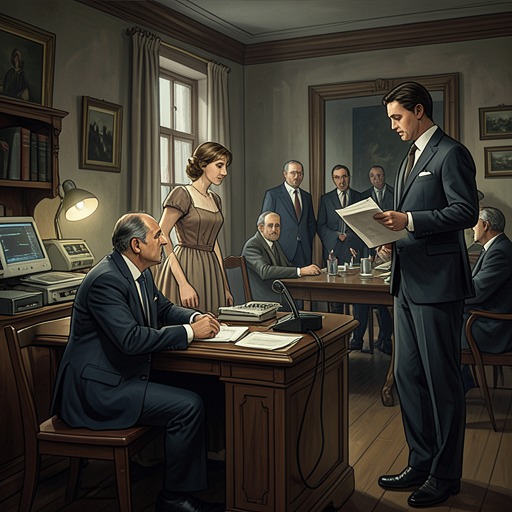
Devereaux first wears the nose and glasses when Gracie DuBois comes to see him. He has directed that she be frisked before entering, then receives her in the costume, hoping for a reaction. The mustache has been detached because, in his view, it would push the effect from slight exaggeration into broad parody. The disguise is therefore not an attempt at convincing concealment; it is a carefully calibrated provocation.
Gracie asks whether they can conduct the meeting like adult professionals. Her response disappoints Devereaux, who had expected at least a double take. He imagines that if their positions were reversed, the sight of her in an altered appearance might briefly make him fear that he had harmed her more seriously than intended. In his account, that flash of guilt would make the comic nose seem real through the pressure of moral imagination. Gracie shows no such response. The prop exposes the limits of Devereaux’s joke: its effect depends less on what it looks like than on whether the other person will enter into the moral and comic fiction he has staged.
Later, as he tells Gracie that they understand each other better than they understand themselves, Devereaux puts the false nose and glasses back on to illustrate his point. He also warns that he expects to file a grievance against her, a remarkable threat from someone who has never before filed or even threatened one against a colleague. In this exchange the disguise accompanies a shift from teasing performance to professional retaliation. It does not soften the conflict; it gives Devereaux a comic surface behind which he can make a serious threat.
From Disguise to Broadcast
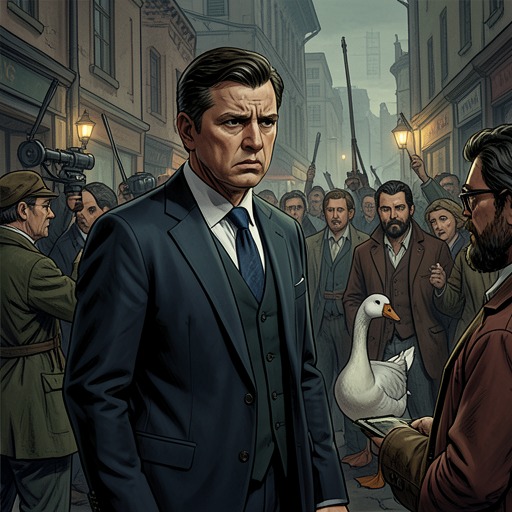
The objects acquire a much larger audience during the campus television encounter involving Tony Coniglia and Finny the Goose. When Finny nips Devereaux’s pinkie, Devereaux puts his hand into his jacket pocket to protect it. The goose follows the hand, reaches into the pocket, and seizes the nose and glasses. Devereaux wrests them away. The tug-of-war over an object that Finny has no use for leaves the goose trumpeting and flapping, while a camera crew records the disorder.
Devereaux’s response turns abruptly from scuffle to public address. Still wearing the fake nose and glasses, he takes hold of Finny by the neck and faces the camera. He identifies himself as a department chair who wishes to remain anonymous, then explains that he lacks next year’s budget for the adjunct instructors needed to cover freshman composition. The university, he says, has committed millions to a new building while failing to fund roughly a dozen additional composition sections, each costing three thousand dollars. He delivers the argument concisely for television and frames it as an indictment of the institution’s educational priorities.
He then threatens to kill a duck each day until he receives a budget, demanding the money by Monday. The disguise is now part of an image that is both comic and alarming: a professor making a budget ultimatum while holding a goose, his face altered by a false nose. The object does not keep him out of sight. It accompanies the moment when he deliberately addresses the camera and makes himself, his department’s shortfall, and his threat visible.
The Image on Television
At The Tracks, Devereaux and the others watch the broadcast. The station has left most of his unprepared remarks in the segment, and he regrets that they were not cut. On the large screen, the nose is recognizable as fake in close-up, but the glasses do not look obviously toy-like and the flesh-colored plastic reads simply as a large nose. Devereaux wonders whether viewers watching ordinary televisions will take it for his real appearance. The intended exaggeration has not translated as clearly as he expected.
The broadcast also reveals a difference between the disguise’s comic purpose and the scene’s consequences. Devereaux had counted on a reaction from Gracie and had treated the nose as a controlled visual gag. On television, the same object is caught beside Finny’s bulging eyes and flapping wings, images that make the threat appear serious to viewers. Meanwhile, the bar crowd cheers, and Missy Blaylock makes Devereaux stand and take a bow, even putting on his spare nose and glasses so the crowd can see that the televised figure is the same man. Dickie Pope and local representative Jack Proctor appear unsmiling, but their brief remarks are drowned out by boos before the segment returns to the laughing studio team.
Comic Concealment and Exposure
The Fake Nose and Glasses work through unstable concealment. Devereaux uses them to stage a joke and to claim anonymity, but they neither erase his recognizable features nor prevent the camera from recording him. Indeed, their uncertain realism makes the disguise more conspicuous: to Devereaux, the nose is a prop; to some viewers, it might simply be his face. The object thus turns a private comic device into part of a public image whose meaning he cannot fully control.
Its appearances also mark changes in the stakes around Devereaux. In Gracie’s office, the nose frames a personal and departmental confrontation; at the campus filming, it is caught in a physical struggle with Finny; in the broadcast, it accompanies a demand about staffing and university priorities. Across these scenes, the prop remains cheap and ridiculous, while the actions around it grow harder to dismiss as mere comedy. Its central irony is that the disguise meant to exaggerate and obscure Devereaux instead helps make his protest memorable.